Wuque DiamondHE Switch Lab
Three switches. One limited tester unit. RGB photos, stem wobble clips, off-centre press tests, and WASD sound comparison.
These switches were provided by Wuque Studio for testing and feedback as part of their 50-tester programme. Wuque did not approve this review before publishing. All photos, videos, observations, and conclusions are my own.
At a Glance
Four observations based on what the available samples, photos, and test media actually show.
Cullinan — clearest RGB showcase
Fully clear PC housing and Transparent PA12 stem pass light through with zero tinting. Under south-facing LEDs, Cullinan produces the sharpest and most direct colour output of the three. The official sound profile is Muted — refined and articulate, closer to a premium muted linear than anything harsh.
Heart of the Ocean — the Blue Diamond identity
Light blue transparent PC top and bottom, Light Blue POM stem, Frosted Transparent PC light guide. The most cohesive themed aesthetic in the lineup — consistently blue and atmospheric across every lighting mode. Official sound profile: Deep Thock. The best sounding of the three in my WASD test.
Poseidon — the feel pick
PC top housing, Light Blue POM stem, Frosted PC diffuser, N52 magnet, and 50 ± 7 gf bottom-out. The most mechanically distinct of the three — and in this session, the most satisfying to press. The heavier bottom-out gives it a soft, full-bodied landing. No official sound profile is listed in the provided spec sheet.
Biggest unknown — full session still needed
Stability and sound impressions come from G, H, and J key positions only. Full-board feel, long-term lube consistency, batch-wide quality, and extended daily use all remain untested. These are first impressions, not final conclusions.
Meet the Lineup
Three switches. One Hall Effect mechanism. Different materials, different optical personalities.
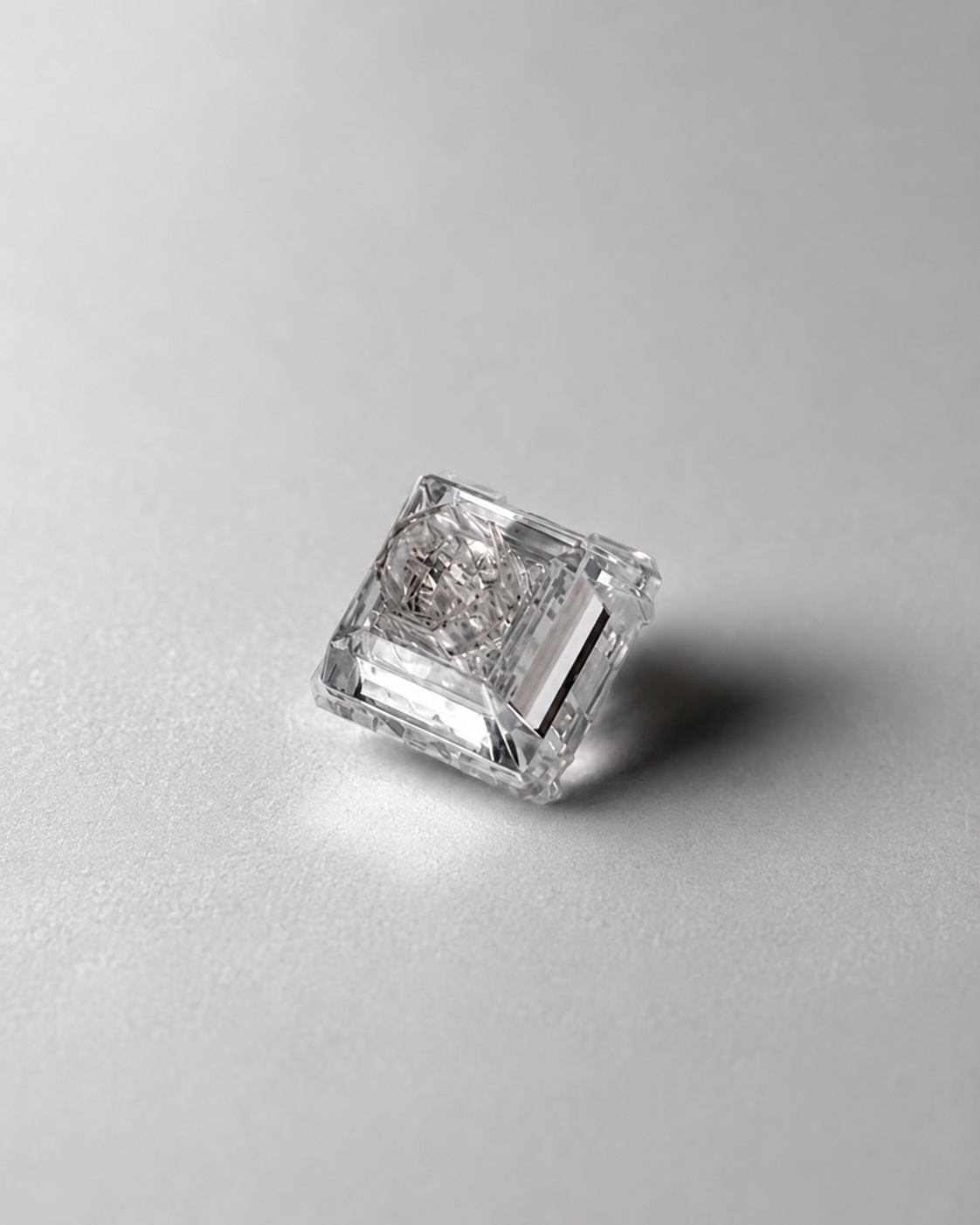
Cullinan
Fully transparent PC housing top and bottom, with a transparent PA12 stem. With south-facing LEDs, the clear construction means light travels through the switch with zero tinting — the most direct and articulate RGB output of the three. PA12 (nylon) is uncommon as a stem material and contributes to both the visual clarity and the refined, muted sound character.
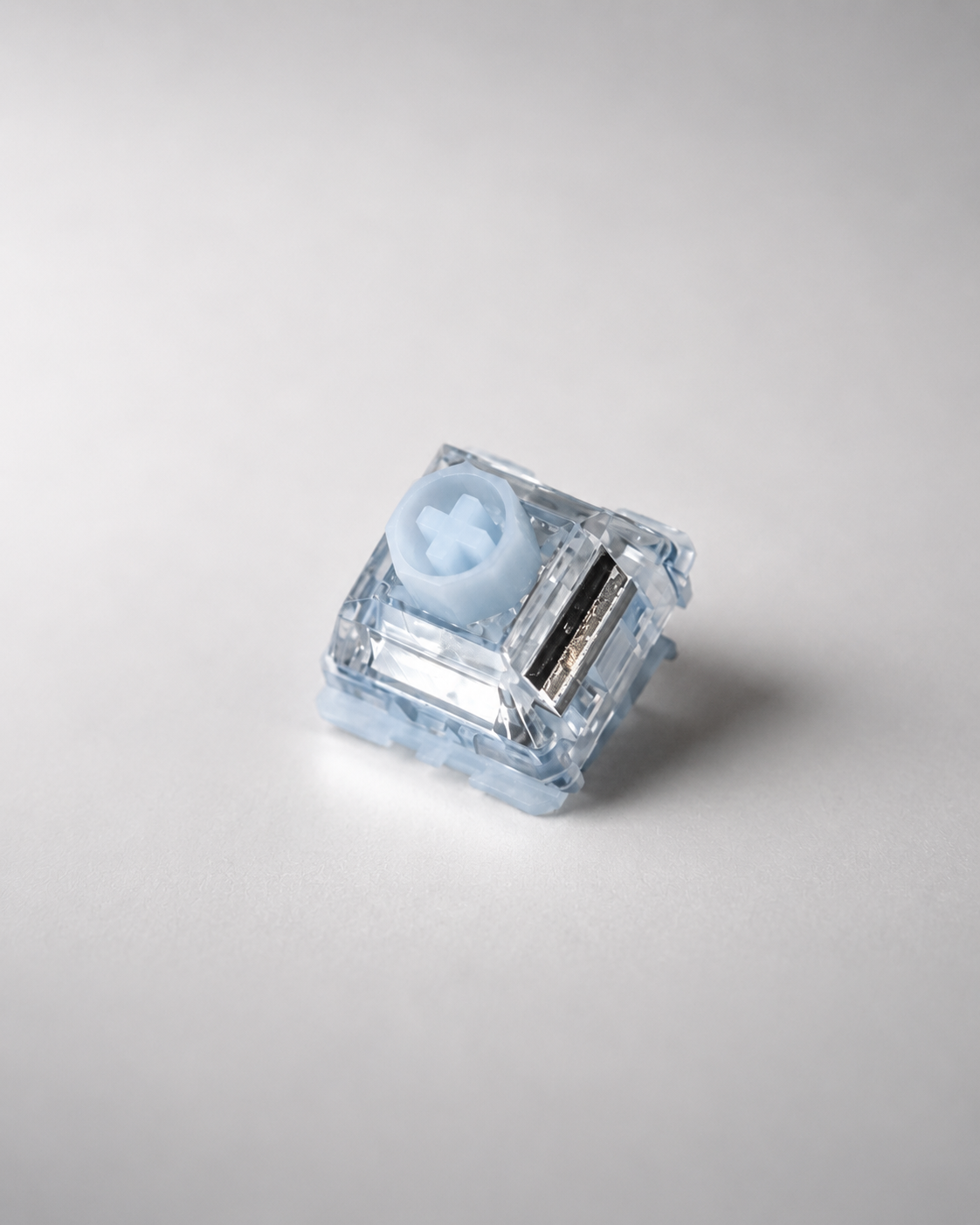
Heart of the Ocean
Light blue transparent PC housing top and bottom, light blue POM stem, and a frosted transparent PC light guide. The strongest themed visual identity of the three. With south-facing LEDs, the blue housing tints the light before it reaches your eye — cooler, moodier, and more atmospheric than Cullinan. The frosted light guide adds subtle diffusion that softens the glow without losing directionality.
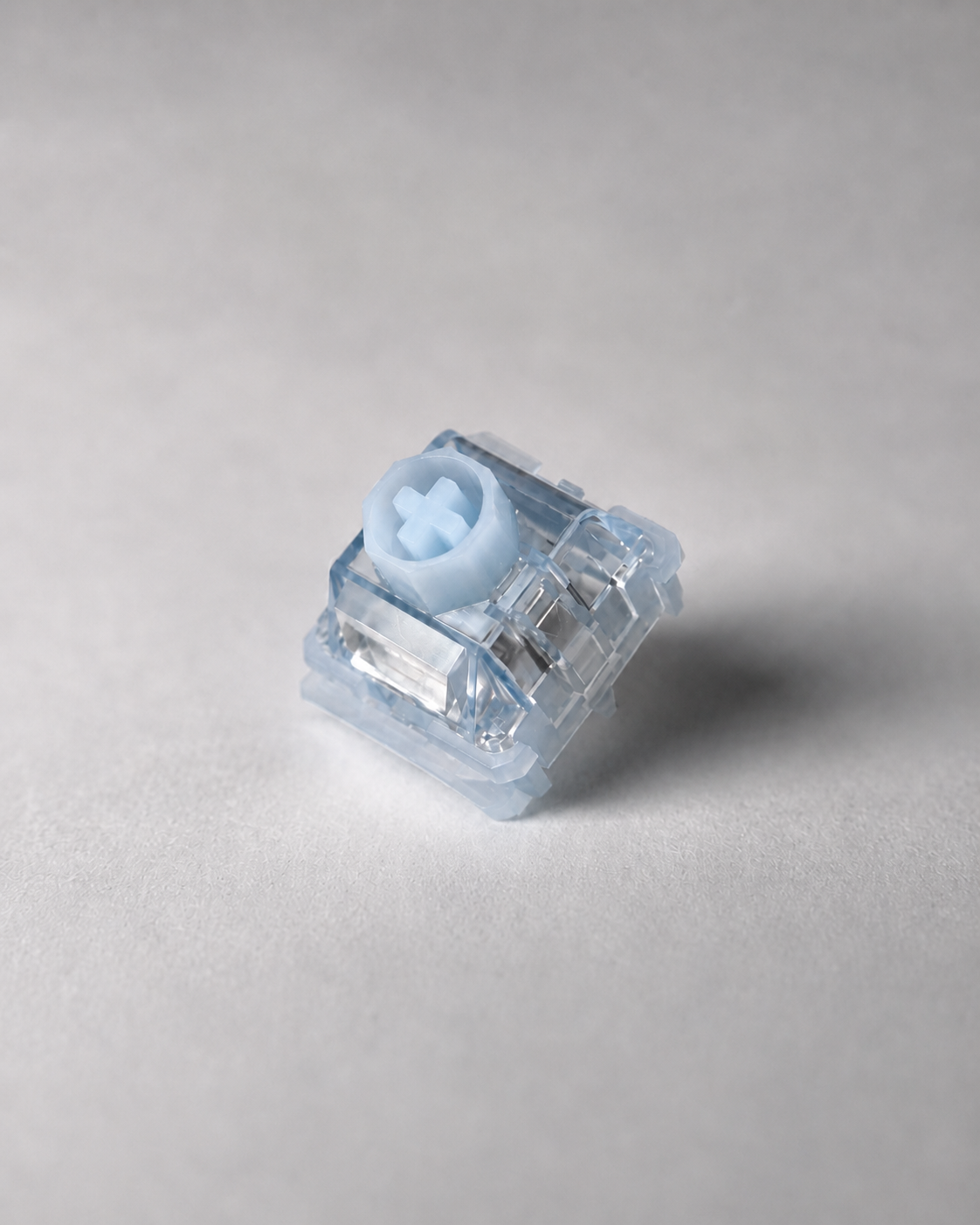
Poseidon
PC top housing, light blue POM stem, light blue PC bottom housing, and a frosted PC diffuser. The most mechanically distinct of the three — N52 magnet and a 50 gf bottom-out (5 gf heavier than Cullinan and HoTO). The frosted diffuser scatters light more broadly than Cullinan's clear pipe. No official sound profile is listed by Wuque.
Cullinan · Heart of the Ocean · Poseidon
All three share the same spring, travel, flux values, and HE mechanism. The real differences are material choices, optical design, and Poseidon's distinct magnet and bottom-out force.
What actually differs
All three share the same spring dimensions, total travel, and magnetic flux targets. The biggest mechanical differences are Poseidon's N52 magnet and 50 gf bottom-out. The biggest material differences are Cullinan's transparent PA12 stem, HoTO's frosted transparent PC light guide, and the different housing transparency levels across the three models.
| Parameter | Cullinan | HoTO | Poseidon | Notes |
|---|---|---|---|---|
| Top Housing | Fully Transparent PC | Light Blue Transparent PC | PC (Polycarbonate) | Clear vs blue-tinted vs neutral PC — biggest visual difference across all lighting modes |
| Bottom Housing | Fully Transparent PC | Light Blue Transparent PC | Light Blue PC | Cullinan and HoTO are fully transparent; Poseidon adds blue tint at the base |
| Stem Material | Transparent PA12 | Light Blue POM | Light Blue POM | PA12 (nylon) on Cullinan only — uncommon material, higher light transmission than POM |
| Light Guide / Diffuser | Transparent PC | Frosted Transparent PC | Frosted PC | Transparent pipe vs frosted diffuse vs frosted scatter — dominant optical difference |
| Official Sound Profile | Muted | Deep Thock | — | Per Wuque product spec · board, plate, and foam will modify actual output significantly |
| Magnet | 3.6 mm central large magnet | 3.6 mm central large magnet | N52 | N52 on Poseidon only — Wuque has not published calibration or compatibility notes |
| Bottom-out Force | 45 ± 7 gf | 45 ± 7 gf | 50 ± 7 gf | 5 gf heavier on Poseidon — the only mechanical difference and clearly noticeable |
| Switch Type | Linear | Linear | Linear | Identical across all three |
| Initial Force | 35 ± 5 gf | 35 ± 5 gf | 35 ± 5 gf | Identical across all three |
| Total Travel | 3.50 ± 0.10 mm | 3.50 ± 0.10 mm | 3.50 ± 0.10 mm | Identical across all three |
| Spring Diameter | 6.65 mm | 6.65 mm | 6.65 mm | Identical across all three |
| Spring Length | 23 mm | 23 mm | 23 mm | Identical across all three |
| Init. Flux (1.2 mm PCB) | 130 ± 15 Gs | 130 ± 15 Gs | 130 ± 15 Gs | Identical across all three |
| Init. Flux (1.6 mm PCB) | 115 ± 15 Gs | 115 ± 15 Gs | 115 ± 15 Gs | Identical across all three |
| B/O Flux (1.2 mm PCB) | 750 ± 70 Gs | 750 ± 70 Gs | 750 ± 70 Gs | Identical across all three |
| B/O Flux (1.6 mm PCB) | 635 ± 50 Gs | 635 ± 50 Gs | 635 ± 50 Gs | Identical across all three |
| Lifespan | 100 million keystrokes | 100 million keystrokes | 100 million keystrokes | Identical across all three |
| Factory Lube | Factory lubed | Factory lubed | Factory lubed | Identical across all three |
◆ Blue dot = differs across models · Flux values listed per PCB thickness (1.2 mm and 1.6 mm)
Specifications are transcribed from the provided Wuque Studio spec sheets. Where an item is not listed, it is marked as not listed rather than guessed. Flux values vary by PCB thickness — both 1.2 mm and 1.6 mm values are listed where provided.
Why PA12 matters for RGB
Cullinan's Transparent PA12 stem has higher light transmission than standard POM — it's uncommon in switch design. This, combined with the fully clear housing, gives Cullinan a noticeably more direct and articulate light output through south-facing LEDs.
HoTO light guide vs Poseidon diffuser
HoTO's frosted transparent PC light guide channels LED output through blue-tinted material — consistent colour throughput, slightly softened. Poseidon's frosted PC diffuser scatters light wider and softer. Same LED source, different visual results.
Poseidon's N52 magnet
Poseidon is the only switch here with an N52 magnet. Wuque has not published much detail on how this compares with the 3.6 mm central large magnet in Cullinan and HoTO, so I would avoid making claims about actuation accuracy beyond the spec sheet. In actual use, the switches calibrated normally through the Rainy 75 RT web hub and I did not notice odd behaviour or dropouts during Valorant sessions — the gaming feel was genuinely pleasant, especially because of Poseidon's softer and fuller landing on repeated WASD.
Shared HE core — identity is the differentiator
All three use the same spring, travel, and flux targets. Poseidon is the only mechanical outlier. Everything else comes down to how each switch looks, sounds, and behaves as a material object — which is exactly what this tester unit tests.
What This Review Can and Cannot Test
Transparency, not apology. Understanding the scope makes the evidence more credible, not less.
Can test
- RGB clarity and light diffusion — all three switches under four lighting modes
- Material and visual comparison — housing colour, stem colour, diffuser character
- Stem wobble — X-axis and Y-axis displacement with keycaps removed (G, H, J keys)
- Keycap wobble and clearance — mounted keycap stability across all three switches
- Centre press — reference press for all three side-by-side
- Off-centre press — top-left and bottom-right corners (all three switches)
- WASD spam sound impression — three separate clips under the same recording setup
Cannot fully test
- Spacebar sound — stabiliser rattle on this board makes spacebar recording unreliable
- Full-board typing sound — not enough switches for a complete board fill
- Full-board consistency — G, H, J sample cannot speak for batch-wide quality
- Long-term lube behaviour — requires months of use, not a short tester session
- Long-term magnetic or actuation consistency — no drift data over time
- Switch-to-switch unit variance — limited to three key positions only
- Lab-grade acoustic or displacement measurements — these are practical visual comparisons only
What I Could Actually Test
Every test listed here has associated media. Confidence reflects sample size and test conditions — not the quality of the switches.
| Test | Media used | What I looked for | Confidence |
|---|---|---|---|
| RGB clarity | 12 photos: rgb / blue / white / no-light · all three switches | Brightness, colour diffusion, housing transparency, and how each switch changes the board visual mood | medium |
| Stem wobble | xaxis_stemwobble_all3_rotated.mp4 · yaxis_stemwobble_all3_rotated.mp4 | Visible stem displacement along X and Y with keycaps removed — G, H, J keys | low–medium |
| Keycap wobble & clearance | keycapwobble_clearance_all3_rotated.mp4 | Mounted keycap lateral movement and visible stability across all three switches | low–medium |
| Off-centre press | centrepress_all3.mp4 · topleft_all3.mp4 · bottomright_all3.mp4 | Whether stem binds or tilts away from centre — all three switches at each position | medium |
| WASD spam | cullinan_wasd.mp4 · poseidon_wasd.mp4 · heartoftheocean_wasd.mp4 | Pitch, sharpness, bottom-out character, and audible ping — per-switch isolated WASD clips | low–medium |
12 photos: rgb / blue / white / no-light · all three switches
Brightness, colour diffusion, housing transparency, and how each switch changes the board visual mood
xaxis_stemwobble_all3_rotated.mp4 · yaxis_stemwobble_all3_rotated.mp4
Visible stem displacement along X and Y with keycaps removed — G, H, J keys
keycapwobble_clearance_all3_rotated.mp4
Mounted keycap lateral movement and visible stability across all three switches
centrepress_all3.mp4 · topleft_all3.mp4 · bottomright_all3.mp4
Whether stem binds or tilts away from centre — all three switches at each position
cullinan_wasd.mp4 · poseidon_wasd.mp4 · heartoftheocean_wasd.mp4
Pitch, sharpness, bottom-out character, and audible ping — per-switch isolated WASD clips
G = Cullinan · H = Heart of the Ocean · J = Poseidon · All clips taken in the same session
Light Diffusion & RGB Clarity
Twelve photos, four lighting modes, three switches — same board, same session. Click any photo to enlarge.
Same board. Same lighting modes. Three different visual personalities.
SOUTH-FACING LEDs · RAINY 75 RT
Cullinan
G key · Fully transparent PC · Transparent PA12 stemClear housing catches saturated RGB strongly. Colours transmit directly with minimal shift — no housing tint. South-facing LEDs shine straight through the transparent PC.
Blue lighting makes the clear housing look icy and clean. Very little housing interference — light passes through almost without modification.
Without lighting, the fully transparent construction is visible. The Transparent PA12 stem and clear PC housing are both easy to inspect — this is what makes it the clearest optical design of the three.
White lighting shows how directly the switch carries brightness through. Minimal diffusion, minimal tint — the clearest and most direct output of the three.
Heart of the Ocean
H key · Light blue transparent PC · Frosted transparent light guideThe light blue transparent housing adds a cool tint to all colours under mixed RGB. Warm tones shift noticeably — the most distinctively themed of the three.
Blue lighting reinforces the ocean identity most strongly here. The fully blue-tinted housing amplifies the hue across the whole switch — top, stem, and bottom.
Without lighting, the light blue transparent PC housing and light blue POM stem are visible throughout. Top, bottom, and stem all match — a cohesive material identity.
White lighting shows the frosted transparent PC light guide diffusing glow through blue-tinted material — a wide, consistently blue character. The most atmospheric of the three under white.
Poseidon
J key · PC top · Light blue PC bottom · Frosted PC diffuserPoseidon sits between Cullinan and HoTO under RGB. The neutral PC top housing and light blue PC base give it a balanced cooler character without the full blue saturation of HoTO.
Blue lighting brings out the light blue POM stem and bottom housing. The frosted PC diffuser gives a softer, more scattered look than either Cullinan or HoTO in this mode.
Without lighting, the light blue stem and bottom housing are visible against the neutral PC top. The frosted diffuser is also visible here — a layered construction compared with the simpler all-clear Cullinan.
White lighting shows the frosted diffuser scattering — the light output is softer and wider than Cullinan, but more restrained and less themed than HoTO.
Photos show practical visual character, not calibrated brightness · OnePlus 13R Pro Mode · Fixed 6500K white balance · Same board · Same keycap set · Same session · Click to enlarge
Stem Wobble · Off-centre Press · Keycap Clearance
Six clips, all three switch positions side by side. Sample-level observations — not a full production tolerance audit.
Headline finding: X-axis and Y-axis wobble are little to non-existent across all three switches — even with keycaps installed. That is genuinely impressive for factory-stock HE switches and speaks well to the build quality of the Diamond series. These are sample-level observations, but the consistency across the three positions is encouraging.
Centre press — all three
G = Cullinan, H = HoTO, J = Poseidon. The three samples look broadly consistent on straight-down presses. No obvious binding from centre input — this is mainly the baseline before checking off-centre behaviour.
↳ Reference clip. Compare against the off-centre tests below.
Top-left off-centre — all three
G = Cullinan, H = HoTO, J = Poseidon. This checks whether the stem tilts, hesitates, or introduces scratchiness when force is applied away from centre. In this sample, the behaviour still looks well controlled — no dramatic failure point visible.
↳ Sample-level observation only. Not a batch tolerance result.
Bottom-right off-centre — all three
G = Cullinan, H = HoTO, J = Poseidon. Opposite corner to top-left. Again, the differences look subtle rather than dramatic. The switches handle uneven input without an obvious change in character across the three samples.
↳ Sample-level only. Cannot be used to predict full-batch consistency.
X-axis stem wobble — all three
G = Cullinan, H = HoTO, J = Poseidon. With keycaps removed, side-to-side stem movement appears minimal across all three. Nothing here suggests sloppy tolerance or obvious looseness — wobble is little to non-existent in this axis.
↳ Keycaps removed · Single-unit sample per switch.
Y-axis stem wobble — all three
G = Cullinan, H = HoTO, J = Poseidon. Front-to-back movement also appears very low. Combined with the X-axis and keycap-on results, the overall impression is that wobble is impressively well controlled across the sample.
↳ Keycaps removed · Y-axis often differs from X-axis due to stem geometry.
Keycap wobble and clearance — all three
G = Cullinan, H = HoTO, J = Poseidon. With caps installed, all three still appear stable. This is closer to real use and the result that matters most in practice. Clearance looks clean and movement is controlled rather than sloppy.
↳ Keycap mounted · The state that matters for actual typing.
Sample-level note: These clips cover only the three key positions I received — G, H, and J. They are useful for relative comparison in this session, but switch behaviour can vary between units and board positions. Do not extrapolate these results to full-batch consistency without further testing.
WASD Spam — Three Switches
Three isolated clips, one per switch, recorded on the same board in the same session. WASD spam only — not a full typing test.
Transparent PA12 stem · Fully clear PC housing · Official: Muted
Cullinan sounds the most refined and controlled of the three. It has a clean, muted repeated press character with a slightly sharper and more articulate top note than the POM stem switches. I am mainly listening for whether it sounds softer or sharper than the POM stem variants — in this setup it comes across as premium muted rather than dull.
Light Blue POM stem · Light Blue Transparent PC housing · Official: Deep Thock
Heart of the Ocean sounds slightly deeper and rounder than Cullinan in this setup. The official Deep Thock profile makes sense here. The bottom out has a fuller, more polished thock quality, and the light blue POM stem gives it a softer acoustic character. To my ear, it lands closest to what I associate with a polished HE thock switch.
Light Blue POM stem · PC top + Light Blue PC bottom · N52 · 50 gf B/O
Poseidon is the deepest and fullest sounding of the three in my isolated WASD test. The heavier 50 ± 7 gf bottom out and N52 magnet make it feel more mechanically distinct. It has the softest landing and the most satisfying repeated press feel in this session. Coming from the TTC King of Magnetic on a different reference board, Poseidon feels on another level in terms of fullness and overall press satisfaction.
Personal baseline: My reference for Hall Effect sound is the TTC King of Magnetic on a different reference board. Against that: Cullinan sounds more refined and controlled; HoTO comes closest to the deep, rounded thock quality I associate with a polished HE press; Poseidon adds the heaviest landing and is the most full-bodied of the three. All three are quieter and more composed than I expected on the CF plate.
| Dimension | Cullinan (G) | HoTO (H) | Poseidon (J) |
|---|---|---|---|
| Official sound profile | Muted | Deep Thock | Not listed in provided spec sheet |
| Pitch (in this setup) | Mid · clean and articulate | Low-mid · slightly deeper and rounder | Low-mid · fullest and most substantial |
| Harshness | Low · no harshness detected | Low · smooth from start to bottom-out | Low · very smooth, softest landing |
| Bottom-out character | Clean and muted · decisive without being loud | Thocky and rounded · the most polished | Deep and soft · heavier weight adds presence |
| Obvious ping | None audible in this clip | None audible | None audible |
| Repeated press consistency | Very consistent across the clip | Consistent | Consistent |
| Short overall take | Refined and direct · premium muted character | Deeper and more atmospheric · best thock of the three | Fullest and softest · the most satisfying overall |
Same board · Same keycap set · Same recording chain · G = Cullinan · H = Heart of the Ocean · J = Poseidon
How This Was Shot
Full hardware and conditions for this session. Included so readers can judge the evidence in context.
Recording chain: OnePlus 13R Pro Mode, fixed 6500K white balance + Maono AU-A04 at ~10–15 cm · Quiet bedroom with fans, no treatment · Board resonance, foam, and plate all contribute to audio · Spacebar excluded — stabilisers on this board are rattly and would contaminate the comparison · Sound clips are relative comparisons between the three switches only — not an absolute acoustic measure.
Tester Notes
Honest observations from the three-switch testing round, aimed at being useful for the product team.
What Wuque got right
Three genuinely distinct identities within one switch family. Cullinan, Heart of the Ocean, and Poseidon each have a clear character that holds across every test condition — and they manage this without changing the core Hall Effect mechanism. That is harder to achieve than it looks.
HoTO's Deep Thock profile is the most characterful of the three in my WASD tests, which lines up with its premium thock marketing. Poseidon's heavier bottom-out and N52 magnet give it a different feel signature, not just a different colour. These are real product differences, not just visual ones.
What could be clearer
The real-world impact of Poseidon's N52 magnet versus the 3.6 mm central magnet on the other two is never explained in the tester materials. Does it affect HE calibration sensitivity, actuation resolution accuracy, or the precision of advertised actuation points? A brief technical note from Wuque would help buyers decide.
More detail on manufacturing tolerance expectations would also be useful — specifically, how precisely the switches track to their advertised actuation points, what batch-to-batch variance is acceptable, and how much switch-to-switch variation is considered within spec. Poseidon's sound profile is also notably absent from the spec sheet.
What I want to test next
A full 65-piece set of each variant for a proper board-wide comparison — that is the only way to evaluate full-board sound at scale, long-term lube behaviour, and batch-wide uniformity. Three key positions cannot represent that.
I also want to test each switch in different build configurations. Everything here was on the CF plate with the stock CNC aluminium case. Different plate materials, different cases, with and without foam, and different PCBs would likely produce meaningfully different sound results — especially for Poseidon, where the heavier bottom-out character may behave very differently on a softer mount.
Especially Poseidon across longer Valorant sessions. It currently feels like the strongest feel pick in this limited test, and extended daily gaming use is the most meaningful follow-up I can do before recommending it with confidence.
The Honest Take
Based only on what three limited samples, RGB photos, wobble clips, and WASD sound impressions can actually show.
Cullinan
The strongest RGB showcase of the three. Fully clear PC housing and transparent PA12 stem pass light through with zero housing tint. Under south-facing LEDs, colours appear sharp, saturated, and direct. The sound character is refined and muted — a clean premium daily driver. If you are building for maximum RGB output or a crystal-clear switch aesthetic, Cullinan is the one.
Heart of the Ocean
The clearest aesthetic story of the three. Light blue transparent PC housing runs top and bottom, a frosted transparent light guide channels that blue character upward, and the Deep Thock sound profile is the most polished and thocky in my WASD test. The strongest themed visual identity in the Diamond lineup, and the best sounding one based on this session.
Poseidon
The most mechanically distinct switch here, and in this session the most satisfying to press. The N52 magnet and 50 ± 7 gf bottom-out give it a softer, more full-bodied landing. In Valorant sessions on the Rainy 75 RT, it felt controlled, responsive, and genuinely pleasant under repeated WASD. Against my TTC King of Magnetic baseline, Poseidon comes closest to the feel quality I would want in a daily driver.
Wait for more data
Three key positions cannot speak to full-board consistency, long-term lube behaviour, or batch-wide quality. WASD sound is a starting point, not a conclusion. Extended typing feel, plate and case interactions, and Poseidon's N52 magnet behaviour over time all remain untested. If any of those matter to your purchase decision, hold off until larger-scale reviews are available.
Cullinan is the cleanest RGB showcase. Heart of the Ocean has the strongest themed identity and the most polished thock character in this session. Poseidon is my personal feel pick. The N52 magnet and heavier 50 ± 7 gf bottom out make it feel fuller, softer, and more confident in repeated movement inputs. If I were choosing based only on this tester unit, Poseidon is the switch I would want to keep using. If full board consistency matters, wait for larger scale testing.
This is not the final word on the Wuque Diamond HE switches. Full-board sound, long-term lube consistency, batch-wide stability, Poseidon N52 magnet behaviour over time, and extended daily use all remain untested. These are first impressions from three key positions, one build configuration, and one tester unit.